

Samsung Washer Repair in Nampa, ID
Nampa's hard groundwater leaves mineral deposits that can affect your Samsung washer's performance over time, potentially causing buildup in fill valves and reducing wash effectiveness. Floyd Appliance Repair connects you with local independent providers who diagnose and repair Samsung washers, getting you back to clean laundry without the wait for distant service calls.
Samsung Washer Repair for Nampa Homeowners
Nampa homeowners rely on washing machines year-round, but the region's hard groundwater can accelerate mineral buildup inside Samsung washers, affecting their performance and lifespan. When water quality issues combine with the wear that comes from regular use, Samsung washers may develop problems ranging from drainage slowdowns to sensor malfunctions. Power fluctuations from spring and summer thunderstorms—not uncommon in the Treasure Valley—can also stress the electronic controls that Samsung models depend on, sometimes triggering unexpected shutdowns or error codes. When your Samsung washer stops working as it should, a fast local repair keeps your laundry routine back on track.
Floyd Appliance Repair connects Nampa homeowners with independent local appliance repair providers who know Samsung washers inside and out. These providers take time to diagnose the root cause—whether it's water quality-related scale, an electrical issue, or a mechanical failure—and explain what they find before moving forward. They work with genuine parts and focus on getting your specific Samsung model running reliably again, not just patching a symptom. When you call, you're reaching someone local who can often respond quickly and help you restore your washer without the wait or hassle of big-box chains.
Common Samsung Washer Error Codes
Samsung documents these twelve codes most often on washers. Seven typically trace to something simple — a blockage, a latch, a setting — and five to a component that needs replacing.
Samsung Washer 4C
Often clearable without a technician
What it means: The washer asked for water and did not get what it expected, so it has stopped rather than run a cycle dry. Samsung shows this as 4C on newer panels, 4E on older ones and nF on some models — one fault, three displays.
Why it happens: Almost always something before the machine rather than inside it: a supply tap not fully open, a kinked fill hose behind the unit, or the small mesh screens where the hoses meet the washer silted up with scale and grit.
What you can check: Check both taps are fully open, then pull the machine out far enough to see the fill hoses are not kinked. If that looks fine, turn the taps off, unscrew the hoses at the machine end and look at the inlet screens for debris.
When to call someone: If the supply is good and the screens are clear, the inlet valve on the machine is next, and that is where it stops being an owner check.
Samsung Washer Ub
Often clearable without a technician
What it means: The load has gone off balance in the tub and the washer will not spin it at speed, because an unbalanced drum at spin speed can damage the machine.
Why it happens: Usually one heavy item on its own — a towel, a bath mat, a single pair of jeans — or a load that has twisted into a rope on one side of the drum.
What you can check: Open the door, redistribute the load by hand and restart the spin. Adding a couple of similar-weight items often settles it; washing one heavy item alone rarely spins well.
When to call someone: If it trips on every load including well-balanced ones, the suspension or the sensor reading the drum may need looking at.
Samsung Washer 4E
Often clearable without a technician
What it means: The same not-filling fault as 4C, shown as 4E on older Samsung panels.
Why it happens: A closed or partly closed tap, a kinked fill hose, or blocked inlet screens where the hoses connect.
What you can check: Work from the wall in: taps fully open, hoses unkinked, then the inlet screens at the machine end.
When to call someone: If water reaches the machine freely and it still will not fill, the inlet valve needs testing.
Samsung Washer SE
Often clearable without a technician
What it means: Water is not leaving the machine at the rate the cycle expects, or is not leaving at all. Shown as 5E, SE, 5C or nd depending on the panel.
Why it happens: The debris filter at the bottom front catches coins, hair grips and lint and eventually packs solid. A kinked drain hose or a standpipe that cannot take the flow does the same thing from further down the line.
What you can check: Open the small flap at the bottom front, drain the residual water into a tray and clean the filter. Then check the drain hose behind the machine for kinks and that it is not pushed too far into the standpipe.
When to call someone: If the filter is clean and the hose run is clear, the drain pump itself needs testing.
Samsung Washer UE
Often clearable without a technician
What it means: The same unbalanced-load condition as Ub, shown as UE on some Samsung models.
Why it happens: A single heavy item, or a load that has bunched to one side of the drum.
What you can check: Redistribute the load by hand and restart the spin.
When to call someone: If balanced loads also trip it, the drum suspension is worth checking.
Samsung Washer dC
Often clearable without a technician
What it means: The washer cannot confirm the door is shut and locked, so it will not start or will stop mid-cycle.
Why it happens: Most often laundry caught in the door seal stopping it closing flush, or a door that has been slammed rather than pushed shut.
What you can check: Open the door fully, clear anything caught around the seal, and close it firmly without forcing it. Check the latch and the strike plate for anything obstructing them.
When to call someone: If nothing is obstructing it and the lock still will not engage, the door lock assembly is the usual cause.
Samsung Washer SUd
Often clearable without a technician
What it means: The washer has detected far more foam than the drum is designed to handle, and is pausing to clear it before continuing.
Why it happens: Usually too much detergent, or a standard detergent used in a high-efficiency machine, which foams several times more than an HE formula.
What you can check: Let the machine run its own suds-clearing routine rather than cutting the cycle short. Next load, reduce the dose and check the detergent is HE-rated if your machine needs one.
When to call someone: If it appears with a correct HE dose, something may be holding water in the drum and it is worth having checked.
Samsung Washer 5C
Often clearable without a technician
What it means: The same not-draining fault as 5E and SE, shown as 5C on some Samsung panels.
Why it happens: A packed debris filter at the bottom front, a kinked drain hose, or a standpipe that cannot take the flow.
What you can check: Clean the filter behind the flap at the bottom front, draining the residual water into a tray first, then check the hose run behind the machine.
When to call someone: If the filter is clean and the hose is clear, the drain pump needs testing.
Samsung Washer nF
Often clearable without a technician
What it means: The washer is not filling — the same fault Samsung shows as 4C and 4E on other panels.
Why it happens: A tap that is not fully open, a kinked fill hose, or the inlet screens where the hoses meet the machine blocked with scale and grit.
What you can check: Check both taps, straighten the hoses, then turn the taps off and inspect the inlet screens at the machine end.
When to call someone: If water reaches the machine freely and it still will not fill, the inlet valve is next.
Samsung Washer OE
Usually needs a technician
What it means: There is more water in the tub than there should be, so the washer has stopped filling and is trying to pump out.
Why it happens: Normally the inlet valve passing water when it has been told to close, rather than anything to do with the load or detergent.
What you can check: Turn the supply taps off at the wall so no more water can arrive. There is no owner-side fix for a valve that will not shut.
When to call someone: Promptly — a valve stuck open is a flood risk as well as an error code.
Samsung Washer 0E
Usually needs a technician
What it means: The same overfill condition as OE, shown with a zero on some panels.
Why it happens: An inlet valve letting water through when it should be closed.
What you can check: Shut the taps at the wall to stop the fill. Nothing else here is an owner check.
When to call someone: Promptly, for the same reason as OE.
Samsung Washer ddC
Often clearable without a technician
What it means: The AddWash door — the small hatch in the main door — is not registering as closed and latched.
Why it happens: It is easy to push shut without seating the catch, and a trapped sock or glove will stop it closing flush.
What you can check: Open the AddWash door fully, clear anything caught in it, and press it closed until the catch engages.
When to call someone: If it is properly shut and still reads open, the hatch switch needs checking.
Samsung Washer HE
Usually needs a technician
What it means: A fault in the heater circuit, so the machine cannot bring the wash water up to the temperature the cycle asked for.
Why it happens: A component failure rather than anything that builds up, so it usually appears without warning.
What you can check: Nothing here is an owner check — the heater and its circuit are inside the machine.
When to call someone: When you see it. Cold-water cycles may still run, but the machine is not doing what the programme selected.
Samsung Washer 5E
Often clearable without a technician
What it means: The same not-draining fault Samsung shows as SE and 5C on other panels.
Why it happens: A packed debris filter at the bottom front, a kinked drain hose, or a standpipe that cannot take the flow.
What you can check: Open the flap at the bottom front, drain the residual water into a tray and clean the filter, then check the hose run.
When to call someone: If the filter and hose are clear and it still will not drain, the drain pump needs testing.
Samsung Washer LE
Usually needs a technician
What it means: Moisture has been found somewhere inside the machine it should not be — a leak, not a setting.
Why it happens: Water escaping from a hose connection, a seal or the tub reaches a sensor that shuts the cycle down.
What you can check: Turn the supply taps off at the wall and stop using the machine. The code says water is escaping but not from where.
When to call someone: This needs a technician — tracing the source means getting behind or under the machine.
Samsung Washer 3E
Usually needs a technician
What it means: A motor fault — the drive is not behaving the way the control expects.
Why it happens: A failure in the motor or its control circuit rather than anything to do with the load or detergent.
What you can check: Nothing here is an owner check. A single power-cycle at the breaker clears a one-off glitch; a code that returns is real.
When to call someone: If it comes back after a power cycle, the motor circuit needs testing.
| Code | What it means |
|---|---|
| Ub / UE / U6 | The load is unbalanced inside the tub, so the washer cannot spin it safely. |
| 5E / SE / 5C / nd | Water is not draining at the rate it should, or is not draining at all. |
| dC / dC1 / dL | The door is not being detected as closed and locked, so the cycle will not run. |
| SUd / Sd | An over-sudsing condition has been detected and the machine is pausing to let the foam clear. |
| OE / 0E / OC | There is too much water in the washer, which normally means the inlet valve is passing water when it should be shut. |
| LE / 1C | Moisture has been detected somewhere inside the machine that it should not be, which is a leak rather than a setting. |
| HE / HC | A fault in the heater circuit, so the machine cannot bring the water up to temperature. |
| 3E / 3C | A motor fault — the drive is not behaving as the control expects. |
| tE / tC | The temperature sensor is reporting a reading outside the range the cycle allows. |
| bE2 / 6E2 | A button on the control panel is reading as stuck or continuously pressed. |
Don't see your code? Call (208) 225-8557 — we'll help you track it down.
Common Samsung Washer Problems We Fix
Won't Drain
A Samsung washer not draining is often caused by a clogged drain hose, a failing pump, or debris stuck in the filter. The independent local provider Floyd Appliance Repair connects you with will diagnose the cause and restore proper drainage.
Leaking Water
Water pooling under or around your Samsung washing machine typically points to a worn door seal, cracked hose, or faulty valve. A local repair provider from Floyd Appliance Repair will locate the source and repair or replace the leaking component.
Not Spinning
When a Samsung washer won't spin or spin properly, the drum bearing, drive belt, or motor may be worn. The provider Floyd Appliance Repair connects you with will inspect the mechanical parts and recommend the right fix.
Won't Start
A Samsung washing machine that won't power on or respond to button presses could have a faulty control board, door latch issue, or electrical problem. A local technician from Floyd Appliance Repair's network will test and repair the cause.
Loud or Vibrating
Unusual noise or excessive vibration during a wash cycle often signals a worn drum bearing, foreign object in the tub, or unbalanced load sensor. The independent provider you're connected with through Floyd Appliance Repair will identify and resolve the source.
Error Code Displayed
Samsung washers show error codes when a fault is detected—common codes point to drainage, temperature, or sensor issues. A local repair provider from Floyd Appliance Repair will read the code and perform the necessary repair or service.
Why Nampa Homeowners Trust Floyd for Samsung Washer Repair
Fast Local Samsung Washer Repair
Floyd connects Nampa homeowners with independent local providers who respond quickly to Samsung washer breakdowns. A malfunctioning washer disrupts your routine—rapid access to repair means less downtime and faster restoration of normalcy.
Clear Communication Throughout Repair
Samsung washer repair involves specific diagnostic steps. Floyd-connected providers explain what they find, why the repair is needed, and what to expect next—so you're never left guessing about your machine's condition or next steps.
Thorough Samsung Washer Diagnosis
Independent providers in the Floyd network take time to pinpoint the true cause of Samsung washer failures, not just obvious symptoms. Comprehensive diagnosis prevents repeat breakdowns and keeps your washer running reliably longer.
Protection From Electrical Stress Damage
Nampa's spring and summer thunderstorms, along with winter weather events, can send power surges through home circuits. Samsung washers' sensitive electronics are vulnerable to these voltage spikes. Local providers connected through Floyd understand this regional risk and can advise on surge protection for your appliance.
How Our Repair Service Works
Schedule Your Samsung Washer Repair Visit
Contact Floyd Appliance Repair to describe your Samsung washer issue—whether it's a drainage problem, drum malfunction, or cycle failure. We'll connect you with a local Nampa provider who can assess your specific model and arrange a convenient appointment time.
Samsung Washer Diagnosis & Assessment
The independent provider inspects your Samsung washer, tests its components, and identifies the root cause. In Nampa's hard water conditions, mineral deposits may contribute to performance issues; the technician will check for scale buildup and recommend the appropriate repair path.
Complete Your Samsung Washer Repair
Once you approve the repair plan, the provider replaces faulty parts, clears blockages, or adjusts Samsung washer settings as needed. They'll test the unit to confirm it's running properly before finishing, and answer any questions about maintenance or future care.
Need appliance repair in Nampa? Our technicians can help fast.
Call (208) 225-8557Samsung Washer Repair FAQ — Nampa, ID
Samsung Washer Repair addresses issues like drum failures, control board malfunctions, water inlet problems, and drainage blockages. A local independent provider will diagnose the fault, discuss repair options, and replace or fix the faulty component. The scope depends on whether the problem is mechanical, electrical, or related to water flow or drainage systems.
Floyd Appliance Repair works with independent local providers across Nampa to match you with someone who can help. Response times vary based on provider availability and your location within the area. Contact Floyd to describe your Samsung washer issue and get connected to an available provider in your neighborhood.
Repair costs depend on the specific problem, which component needs replacement, and parts availability. Diagnostic fees, labor time, and the part itself all influence final pricing. The independent provider handling your Samsung washer repair will explain costs upfront before proceeding with any work.
Clear the area around your Samsung washer to give the technician easy access. If the washer isn't draining, remove standing water beforehand. Note any error codes or unusual sounds you've noticed. Have your washer's model number ready, and ensure the area has adequate lighting so the provider can work safely and efficiently.
Run cleaning cycles regularly to prevent buildup inside the drum. Don't overload the machine, and use the correct detergent amount. Check inlet hoses for kinks or damage, and wipe the rubber door seal after each wash. These habits help reduce wear and extend the life of your Samsung washer before repair becomes necessary.
Nampa's groundwater contains minerals that can accumulate in washer components over time, affecting water flow and performance. This mineral buildup stresses internal parts and may eventually require cleaning or replacement of inlet valves and screens. Using a water softener or descaling agent periodically can help minimize this wear on your Samsung washer.
Samsung Washer Repair Across Nampa
Nampa's water supply draws from local aquifers that carry significant mineral content, a characteristic of the Treasure Valley region. This naturally hard water accelerates mineral buildup inside Samsung washers over time, affecting both performance and longevity. Residents in established neighborhoods like Downtown Nampa and the Karcher District, as well as newer areas, face the same water chemistry challenge. Regular maintenance and prompt repair of mineral-related issues—such as reduced water flow, spotted clothes, or drum corrosion—help keep machines running efficiently and prevent costlier damage down the road.
Spring and summer thunderstorms in the Nampa area occasionally bring power surges that can stress appliance electronics, including the control boards and sensors in Samsung washers. Winter weather brings its own electrical hazards through similar events. Homes throughout Greenhurst and surrounding neighborhoods rely on consistent, stable power to protect their appliances. If a power event occurs, a Samsung washer may need diagnostic work to confirm the machine is safe to use again. Connecting with a local independent repair provider quickly after electrical concerns arise helps catch potential problems before they worsen.
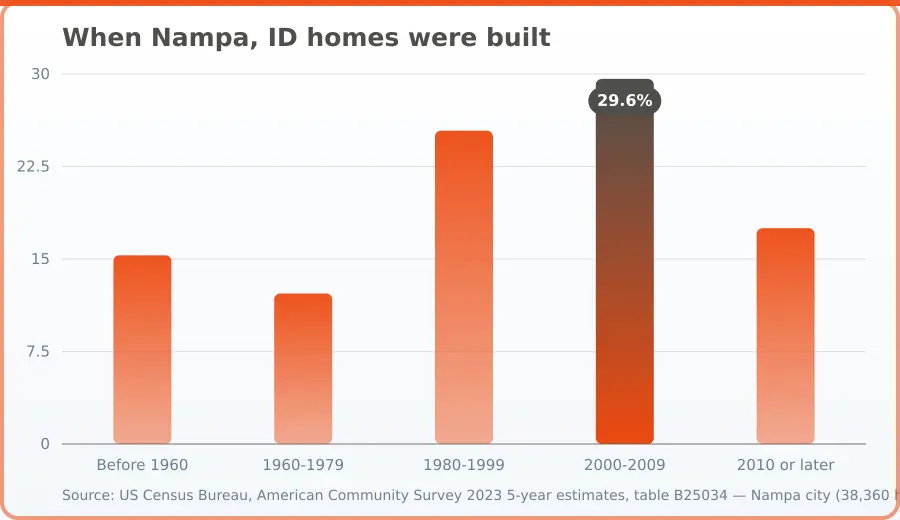
| Period | When homes were built (%) |
|---|---|
| Before 1960 | 15.3 |
| 1960-1979 | 12.2 |
| 1980-1999 | 25.4 |
| 2000-2009 | 29.6 |
| 2010 or later | 17.5 |
Source: US Census Bureau, American Community Survey 2023 5-year estimates, table B25034 — Nampa city (38,360 housing units). Retrieved October 5, 2026.
More Repairs for This Brand
Homeowner Safety Toolkit
Verify Your Nampa, ID Appliance Repair Company
Before you hire anyone, use these independent national resources to confirm credentials, standards, and track record.
ISCET
NASTeC is the appliance repair industry's own national certification exam, administered by the nonprofit ISCET. It's voluntary, so it's worth asking whether your technician holds it.
About NASTeC CertificationBBB
Look up any appliance repair company's complaint history, customer reviews, and accreditation status — a free, independent check before you hire.
Check StandingCPSC
Check whether your specific appliance has an open safety recall before paying for a repair — some recalls cover the fix or a replacement for free.
Check for RecallsBook your Nampa appliance repair today.
Call (208) 225-8557Where We Cover Near Nampa, Idaho
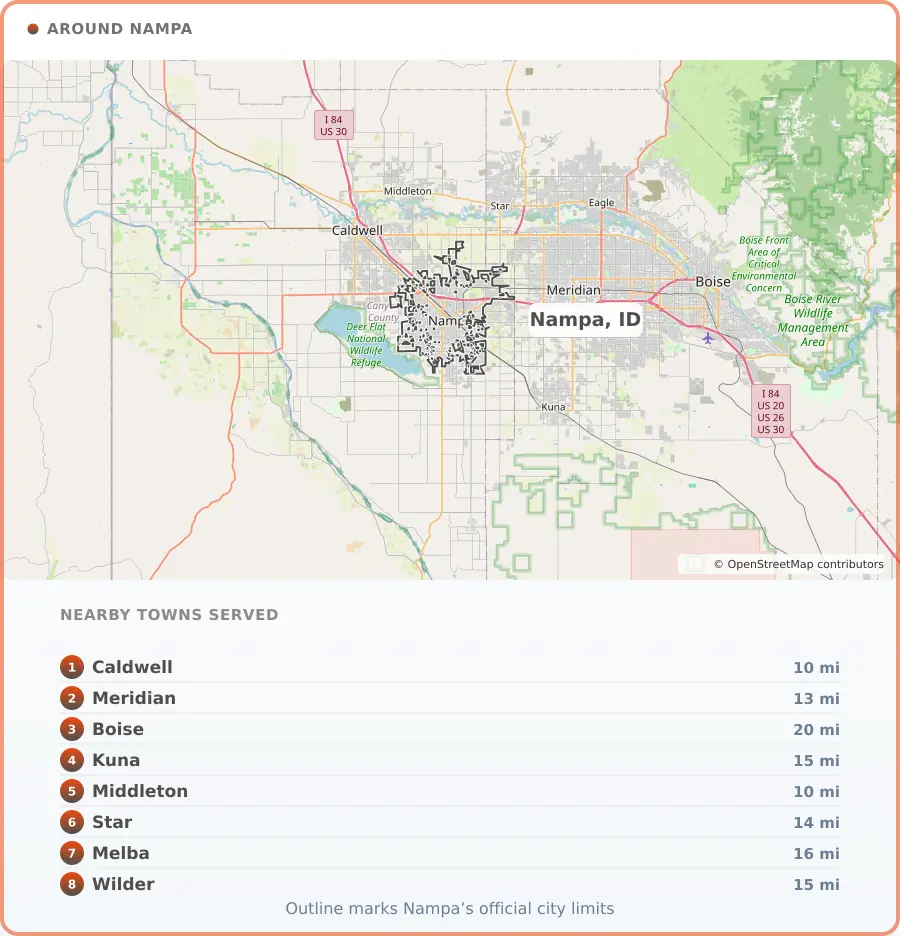
Based in Nampa, ID, with 8 nearby communities inside the service area — near enough to reach quickly, not just listed on a map.
Nampa, ID Information
Nampa sits in southwestern Idaho's Treasure Valley, standing as the state's second-largest city with roughly 106,000 residents and serving as a retail and distribution hub for the greater Boise metro area. The city's roots run through agriculture and food processing—sugar beet refining and dairy manufacturing remain active today—while healthcare and education now anchor much of the local job market, supported by hospital systems and the College of Western Idaho.
Around Downtown Nampa and out toward the Karcher District, the city blends small-town rhythm with steady growth, drawing residents who appreciate open valley views and a close-knit community feel. Between farm fields, classrooms, and clinics, Nampa carries a working, neighborly character that sets it apart from its larger neighbor to the east.
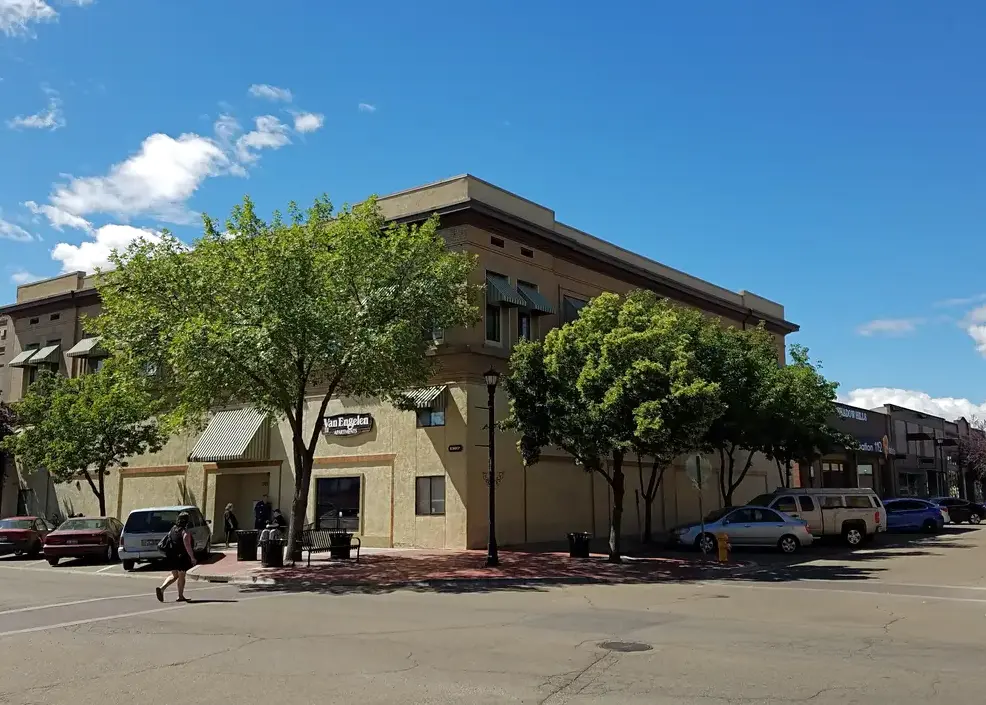
Photo: Tamanoeconomico, CC BY-SA 4.0